Calima & Saharan Dust: The Ultimate Solar Maintenance Guide for the Costa del Sol
In the Axarquía, we live with the 'Calima'—a meteorological phenomenon that can slash solar production overnight. This 3,000-word deep dive explains why it happens, how to track it, and how to safely restore your system's efficiency.
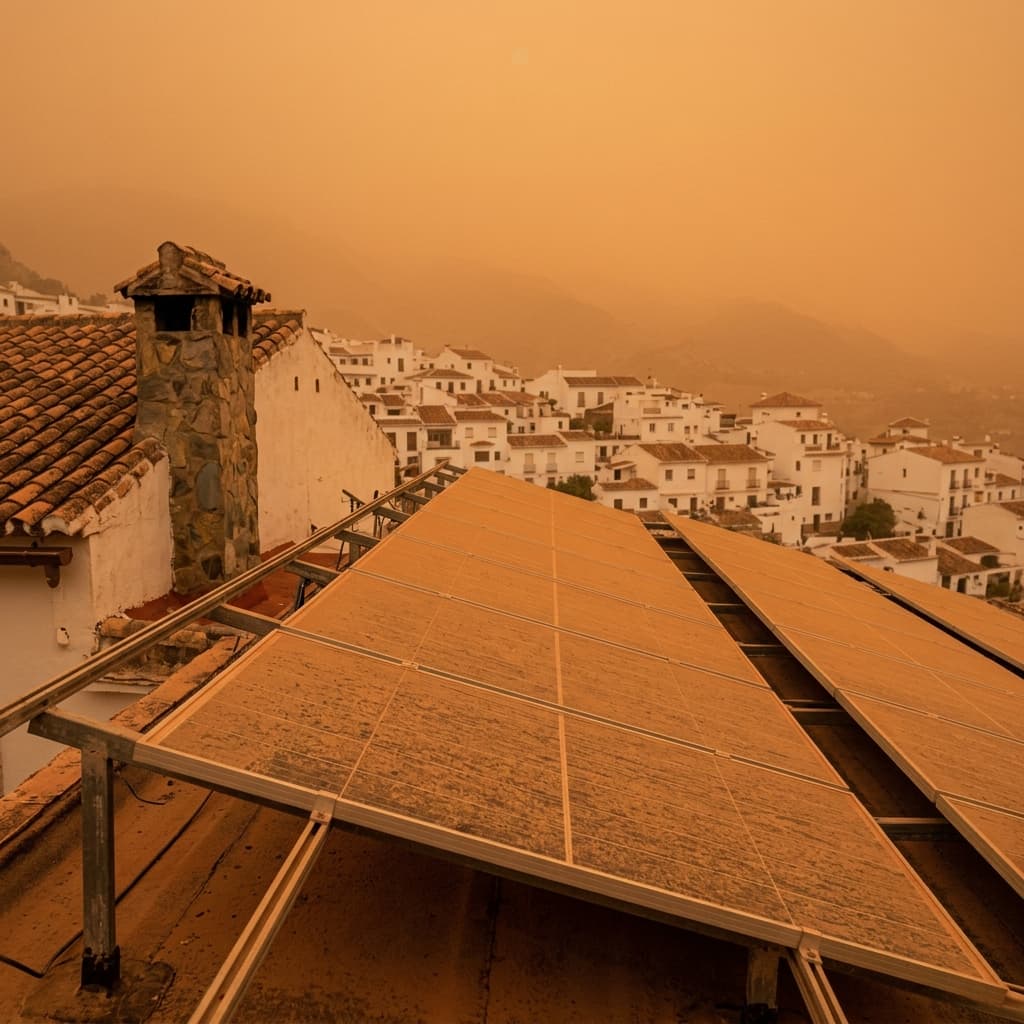
A typical morning after a Saharan Calima intrusion in the Axarquía. Notice the thick, orange mineral layer that blocks 30% of sunlight.
If you own solar panels in Nerja, Torrox, or Vélez-Málaga, you are already familiar with the "Calima." It’s that eerie, orange sky and the layer of red dust that coats your car overnight. But while a dirty car is an aesthetic nuisance, dirty solar panels are a financial drain.
In southern Spain, the Saharan dust is the single greatest environmental threat to your return on investment (ROI). It doesn't just block light; it creates heat hotspots, causes permanent glass etching, and can reduce your system's output by more than half in a single 24-hour period.
Live Calima Tracker
Real-time Saharan dust monitoring for the Axarquía region.
Live Solar Priority Tracker
Ground Sensors + Atmospheric Load
Live Saharan Dust Forecast Map
Interactive map courtesy of Windy.com. Use the slider to view the forecast for the coming days.
The Science of Calima: Why the Costa del Sol?
To understand why your solar panels are under constant siege, we have to look 25,000 feet into the atmosphere. The "Calima" is more than just wind; it is a thermal inversion layer. In the Sahara, intense surface heating creates a layer of hot, dry air that holds billions of tons of particulate matter. When a low-pressure system moves toward the Canary Islands or the Gulf of Cádiz, it acts as a giant vacuum, pulling this Saharan Air Layer (SAL) across the Mediterranean.
The Costa del Sol and the Axarquía are geographically predisposed to be the hardest hit areas in mainland Europe. While cities further north like Madrid or Barcelona might see the sky turn hazy, the Axarquía receives the first "drop" of the heaviest mineral particles.
Technical Deep-Dive: Electrostatic Bonding
Saharan dust is unique among atmospheric particulates. Because it originates in an environment with almost zero humidity, the friction of particles tumbling over each other generates significant static electricity. These particles are "electrets"—they maintain a permanent electric charge. When they hit your solar panel glass (which is itself an insulator), they form a strong electrostatic bond. This isn't just gravity holding the dust there; it's a molecular attraction. This is the primary reason why wind alone cannot "blow" a Calima layer off your panels.
Furthermore, the Axarquía’s micro-climate adds a secondary layer of complexity. The humidity from the sea in Torrox Costa or Nerja interacts with these bone-dry desert particles. The humidity acts as a wetting agent, turning the dust into a micro-slurry. When the sun comes up, this slurry "bakes" onto the glass, essentially creating a thin layer of mineral concrete that remains even after the winds have died down.
The "Barro" Phenomenon: When Rain is the Enemy
In northern Europe, rain is a solar panel's best friend—it provides a free cleaning service. In Spain, we have to deal with lluvia de barro (mud rain). This is perhaps the most misunderstood risk for new solar owners in the region.
This occurs when a light rain shower passes through a dust-laden atmosphere. The raindrops capture the Saharan particles on their way down, resulting in "mud droplets" landing on your PV array.
Dry Deposition
Fine dust settles slowly over days. It is easier to remove but still reduces production by 10-15% per week during peak Calima season. This dust acts as a filter, shifting the spectrum of light reaching your cells and reducing the effectiveness of the blue-light absorption.
Wet Deposition (Barro)
Rain traps the dust. This creates an opaque, hard-water-spotted crust that can block up to 50% of light and won't wash away with standard rain. The "drying edge" of these mud spots often creates localized areas of high resistance, which is where hotspots begin.
The localized impact: Coast vs. Mountains
We see a marked difference in how Calima affects properties based on their altitude. In coastal areas like Torre del Mar, the high saline content in the air acts as a corrosive catalyst for the Saharan dust. The salt and dust together form a crust that is significantly more difficult to remove than pure dust.
In higher altitude villages like Comares or Torrox Pueblo, the dust is often drier and more abundant. Because these areas are closer to the lower atmospheric currents, they often witness higher volumes of deposition. However, the lack of salt means the "etching" process is slower, though the performance loss is often more immediate due to the sheer volume of material.
Calculating the Financial Cost of Calima
Let's look at the numbers. A typical 5kW domestic solar system in the Axarquía during July should produce approximately 30-35 kWh per day.
- Light Dust: Reduces output to ~28 kWh (15% loss). At current rates, that's roughly €1.20 per day in lost savings.
- Heavy Calima: Reduces output to ~20 kWh (40% loss). Now you're losing ~€3.50 per day.
- Post-Mud Rain: Can reduce output to as low as 12-15 kWh (60%+ loss). You are now losing over €5.00 a day.
If you are on a standard electricity tariff, this loss can cost you significant money. Over a month of neglect during dust season, you are literally throwing away €100 or more. Furthermore, if you have a battery system, a 40% loss in production often means your batteries aren't hitting full charge by midday, forcing you to draw from the grid during expensive peak evening hours.
We regularly see systems in areas like Cómpeta and Sayalonga that have lost 40% of their annual yield simply because the owners assumed the rain was cleaning them. In reality, the 'barro' had formed a permanent filter over the silicon cells. We recently cleaned an 8-panel array in Nerja that saw an immediate 70% jump in production—the owner thought his inverter was broken!— Technical Lead, Axar Solar Clean
Common Calima Myths Debunked
Myth 1: "Rain will clean it eventually."
False. As discussed, the Saharan dust often contains mineral binders that harden when wet. Unless we have a 48-hour torrential downpour (rare in Andalusia), the rain usually just relocates the dirt to the bottom edge of the panels, where it creates "bottom-shading" that impacts the entire string's production.
Myth 2: "A little dust doesn't really matter."
False. Solar panels are non-linear devices. A 10% coverage of dust doesn't just mean 10% less light; it can lead to "mismatch losses" where the entire string's current is limited by the single dirtiest panel. In some cases, a small, thick patch of mud is worse than a light even coating of dust across the whole array.
Myth 3: "Vinegar is great for removing mud spots."
DANGEROUS. While vinegar is a great household cleaner, it is an acid. Many solar panel frames are made of anodized aluminum, and the seals are made of specialized polymers. Acidic cleaners can corrode the frames and degrade the seals, leading to moisture ingress and panel failure (PID - Potential Induced Degradation).
Beyond Production: The Technical Risks of Muddy Panels
It isn't just about the money you lose today; it's about the lifespan of your panels. Calima dust brings three technical risks that many owners overlook:
1. Hot Spot Formation & Resistance
Solar panels are made of strings of cells. If one cell is heavily shaded by a bird dropping or a thick patch of Calima mud while the others are in full sun, that shaded cell becomes a "resistor." It begins to dissipate heat instead of generating electricity. This can lead to localized temperatures of over 100°C. In the Axarquía heat, these hotspots can accelerate the aging of the EVA encapsulant, leading to yellowing and permanent efficiency loss.
2. Glass Etching & Micro-pitting
Saharan dust is chemically active and contains elements like iron oxide and carbonates. When mixed with humidity or sea salt (especially in Nerja), it can create a chemical reaction that "etches" the surface of the solar glass. If the dust is left for months, it can create microscopic pits in the glass. This doesn't just block light; it causes light to scatter, further reducing the panel's ability to focus photons onto the silicon layer.
3. Frame Corrosion & Drainage Blockage
Dust accumulation often builds up at the bottom edge of the panel frame. This "silt" traps moisture against the frame seals and can block the tiny drainage holes designed to let water escape from the frame. If water remains trapped, it can cause delamination—where the glass and cells start to pull apart—ending the panel's life prematurely.
Professional Cleaning: Why Pure Water Matters
Many owners ask why they should pay for a professional clean when they have a hose at home. The answer lies in chemistry and physics.
The Problem with Tap Water
Axarquía tap water (from the Viñuela reservoir or local wells) is "hard," meaning it’s full of calcium and magnesium. When you spray this on your panels and it evaporates in the 30°C+ sun, it leaves behind Limescale. Limescale is chemically identical to rock and is nearly impossible to remove without specialized chemicals that can damage your panels.
The Pure Water Solution
We use a five-stage filtration system that removes every single mineral from the water, bringing it to 000 PPM (Parts Per Million). This "hungry" water has a natural affinity for dirt. It physically grabs the Calima particles and pulls them off the glass. Best of all, it dries perfectly clear, leaving a hydrophobic surface that the next Calima will find much harder to stick to.
Risk Mitigation
- ✓ No high-pressure risk to cell integrity
- ✓ No chemical films or oily residues
- ✓ Safely reaching roofs using carbon fiber poles (no walking on tiles)
- ✓ Insured and specialized equipment
Don't let the dust drain your savings.
The Costa del Sol atmosphere is unique, and your solar maintenance should be too. We understand the specific challenges of the Axarquía—from the Saharan dust to the saline coastal breeze.
DIY Guide: How to Safely Clean Calima Dust
If you decide to tackle the cleaning yourself, you must follow these steps to avoid damaging your multi-thousand euro investment. For more detailed advice, read our guide on Common DIY Mistakes.
Timing is Everything
Never clean hot panels. Applying cold water to glass that has been baking in the Andalucian sun for 6 hours can cause thermal shock, leading to immediate glass shattering. This is not a warranty-covered event. Clean at first light (7:00 AM) or after sunset when the glass temperature has equalized with the air.
The Pre-Rinse (Critical)
Flood the panels with low-pressure water first. Your goal is to float the Saharan grit away from the surface before you ever touch it with a brush. If you scrub immediately, you are essentially using sandpaper on your panels. Let the water run until the runoff changes from brown to clear.
Wrong Water = White Spots
If you must use tap water, you must dry the panels manually with a squeegee. Leaving tap water to air-dry in the Spanish sun will leave mineral residues that are harder than the dust ever was. For best results, use a final rinse of bottled or distilled water if you don't have a de-ionizing filter.
What to ABSOLUTELY Avoid
- XDetergents & Dish Soap: These leave a microscopic film that actually attracts dust faster. It acts like fly-paper for the next Calima and can cloud the AR coating.
- XHard Bristle Brushes: If it's not a soft solar-specialist brush, don't use it. Backyard brooms will ruin your AR coating and scratch the glass.
- XPressure Washers: High PSI can force water past the panel seals, leading to internal corrosion (delamination) that voids your warranty. It can also cause micro-cracks in the silicon.
- XWalking on Panels: It doesn't matter how careful you are; your weight creates micro-cracks that destroy the efficiency of the silicon wafers over time. Always work from a ladder or using reach-poles.
When is the best time to clean?
Based on 5 years of maintenance data in the Málaga region, we have identified the most critical times for scheduling your solar maintenance.
| Season | Dust Activity | Recommendation |
|---|---|---|
| Spring (Mar-May) | High (Peak Calima) | The most critical time. Clean after every major Calima event to maximize production during the ramp-up to summer. |
| Summer (Jun-Aug) | Moderate/Dry Dust | High heat makes dust more dangerous (hotspots). Clean at least once in July to ensure the glass can radiate heat effectively. |
| Autumn (Sep-Nov) | Low/Rainy | The "Mud Rain" season. Monitor your app daily after any light rain to check for performance dips. |
| Winter (Dec-Feb) | Low | One deep clean in January to ensure the low winter sun can penetrate the glass with maximum efficiency. |
The Costa del Sol Maintenance Checklist
If you live in the Axarquía, keep this checklist on your fridge or phone:
- ☐Check your inverter app every Monday morning. A 20% drop compared to the previous week is almost always dust-related.
- ☐Look at your car. If the car has a fine red layer, your solar panels have the same.
- ☐If "Mud Rain" occurs, don't wait for the next rain. Clean it within 48 hours before it bakes on.
- ☐Never use a pressure washer. Just because the tiles need it doesn't mean the glass does.
- ☐If DIY cleaning, always stay on the ground. Roof tiles in Spain are brittle and safety is paramount.
Frequently Asked Questions
Does "self-cleaning" glass exist for Calima?
Hydrophilic coatings do exist, but they are designed for standard urban dust and frequent rain. In the heavy, mineral-rich environment of a Saharan Calima, these coatings are often overwhelmed. They might help slightly, but they are not a substitute for physical cleaning with pure water.
If my app shows 90% production, do I still need a clean?
Most inverter apps compare production against a theoretical maximum that doesn't account for daily temperature fluctuations. Even at 90% reported efficiency, you could have localized "hotspots" developing under dust patches that are damaging the panel structure internally. Consistency is key.
How long does a professional clean take?
For a standard 10-12 panel domestic system, it takes approximately 1 to 1.5 hours. This includes the safety setup, pre-rinse, pure-water brush work, and final inspection.
Protecting Your Solar Legacy
Solar panels are a 25-year investment. On the Costa del Sol, that means they will face over 500 major Calima events during their lifetime. How you handle these events will determine whether your system lasts 10 years or 30 years.
By understanding the science of Saharan dust, using live tracking tools, and adhering to safe cleaning practices, you aren't just getting more electricity—you are protecting the heart of your sustainable home.
Ready for a crystal-clear system?
Our expert team is operating across the Axarquía today. From Nerja to Málaga City, we bring the best in solar maintenance technology to your doorstep.
Related Maintenance Resources:
Servicing Your Local Area
We provide specialist solar cleaning across the entire Axarquía region.
View all service areas